
What Is Full-Hookup Camping — and Why It Matters for Comfort on the Road
Full-hookup, partial hookup, dry camping — learn what each means and which setup best supports a comfortable senior RV experience.
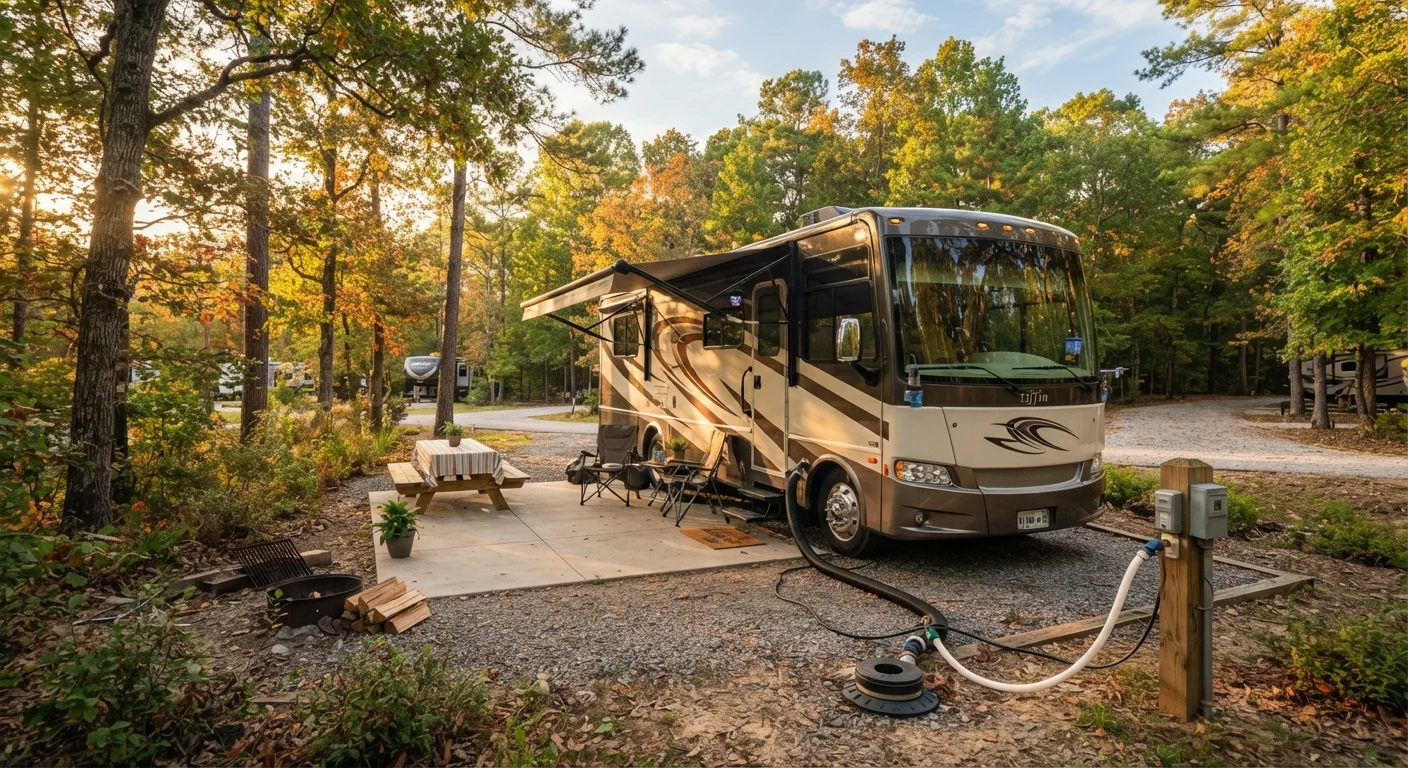
Photo: MyUrbanEscapes.net | Small Escapes. Big Experiences. editorial
—— In This Article
Key Takeaways
- Full-hookup sites provide electricity, fresh water, and sewer connections all at once.
- Partial-hookup sites offer two of three utilities, usually power and water only.
- Dry camping (boondocking) means no utility connections — you rely entirely on onboard tanks and batteries.
- Full hookups are especially beneficial for seniors who value consistent climate control and daily hygiene routines.
- Always confirm the amp rating and sewer access type when booking a site listed as 'full hookup.'
The Three Utility Connections — What Each One Does
Understanding full-hookup camping starts with knowing what each of the three connections actually provides inside your RV.
- Shore power (electricity): A cable runs from the site's pedestal to your RV, supplying consistent power to your air conditioning, refrigerator, microwave, lighting, and any medical equipment such as a CPAP machine. You are no longer drawing down your coach batteries.
- Fresh water: A hose connects your RV's water inlet to a spigot at the site. Water flows on demand — you do not need to ration what is left in your onboard fresh tank.
- Sewer (sanitation): A sewer hose runs from your RV's waste outlet into a drain at the site. Black-water and grey-water tanks drain continuously, so you never need to schedule a dump-station run.
When all three are running simultaneously, your RV functions much like a small apartment. That continuity matters especially if you depend on powered medical devices, have mobility considerations that make dump-station trips inconvenient, or simply want to focus on enjoying your destination rather than managing resources.
The Term 'W/E/S' Explained
In campground listings, 'W/E/S' stands for Water, Electric, Sewer — the shorthand for a full-hookup site. You may also see 'W/E' for partial hookup (water and electric only) or simply 'E' for electric-only sites. Learning this shorthand makes filtering campground search results significantly faster.
For a deeper look at how your RV's water and waste systems work before you connect to any site, see our guide to dump stations, water fills, and grey water management.
Full Hookup vs. Partial Hookup vs. Dry Camping
Campground listings use several terms that are easy to confuse. Here is a plain-language comparison.
30A / 50A
Common electrical service levels at full-hookup sites
Larger motorhomes and fifth wheels with multiple air conditioners typically require 50-amp service for full operation.
3
Utility connections defining a full-hookup site
Water, electricity, and sewer must all be present simultaneously for a site to qualify as full hookup.
| Site Type | Electricity | Fresh Water | Sewer |
|---|---|---|---|
| Full hookup (W/E/S) | Yes | Yes | Yes |
| Partial hookup (W/E) | Yes | Yes | No |
| Electric only (E) | Yes | No | No |
| Dry camping / boondocking | No | No | No |
Partial hookups are common at state parks and many national forest campgrounds. They work well for shorter stays or smaller rigs with larger holding tanks. Dry camping requires the most self-sufficiency — managing battery charge, conserving water, and planning dump-station stops. Understanding your overnight campground options can help you match the right site type to each leg of your trip.
Why Full Hookups Make a Genuine Difference for Senior Travelers
Comfort and consistency take on added weight as we get older. Full hookups support several aspects of daily life that partial or no-hookup sites simply cannot.
Book Full-Hookup Sites Early for Popular Destinations
Full-hookup sites are typically the first to fill at popular campgrounds, especially during summer and fall foliage seasons. If your travel dates are flexible, checking availability mid-week or in shoulder season gives you a better chance of securing your preferred site type. Always confirm site-specific details directly with the campground after booking online.
- Climate control: Running air conditioning continuously on shore power is essential in summer heat or humid climates, where heat stress can be a real concern.
- Medical equipment: Devices that require overnight power — CPAP machines, oxygen concentrators, or powered mobility aid chargers — work reliably without depleting your battery bank.
- Hygiene and routine: Access to continuous fresh water supports daily showers, medication schedules tied to meals, and general wellness routines that contribute to feeling well on a longer trip.
- Reduced physical tasks: Eliminating the need to relocate to a dump station removes a driving and physical exertion task that can be tiring, particularly after a long travel day.
See our RV safety and comfort hub for broader guidance on staying healthy and at ease throughout your travels.
It is also worth reading about accessible campground features that matter — hookup type is just one element of a site that truly supports your needs.
What to Verify Before You Book a 'Full-Hookup' Site
The label 'full hookup' does not guarantee identical service everywhere. A few practical checks before confirming a reservation can prevent surprises.
- Amp service: Ask whether the pedestal offers 30-amp, 50-amp, or both. If your rig needs 50-amp and only 30-amp is available, you may need an adapter and will have reduced power capacity.
- Sewer connection type: Most sites use a standard 3-inch drain opening, but confirm — occasionally older campgrounds have non-standard setups.
- Site surface and level: A hookup means nothing if the site is too sloped or soft-surfaced for your rig to sit level. Ask specifically if sites are paved, gravel, or grass.
- Proximity of connections: Hose and cable lengths matter. Confirm the utility pedestal and sewer cleanout are within reach of your rig's connections without straining or creating trip hazards.
Experienced senior RVers often discover these nuances the hard way. Our article on things senior RVers discover once they're on the road covers similar on-the-ground lessons worth reviewing before your first trip.
If you are considering full-time RV travel, hookup availability at your planned long-stay locations becomes an even more central planning factor — something explored in depth in our piece on full-time RV living in retirement.
Frequently Asked Questions

Rv Travel Editorial Team
RV Travel Editorial Team is the collective byline for our editorial team and contributor network. Articles published under this byline or an editorial pen name are researched, written, and reviewed according to our editorial standards for clarity, consistency, and independence before publication.
View author profile