
A Complete Guide to Cruising With a Mobility Aid: Wheelchairs, Scooters, and Ship Design
Traveling with a wheelchair or scooter requires advance planning at sea. This end-to-end guide covers cabins, gangways, tenders, and shore access.
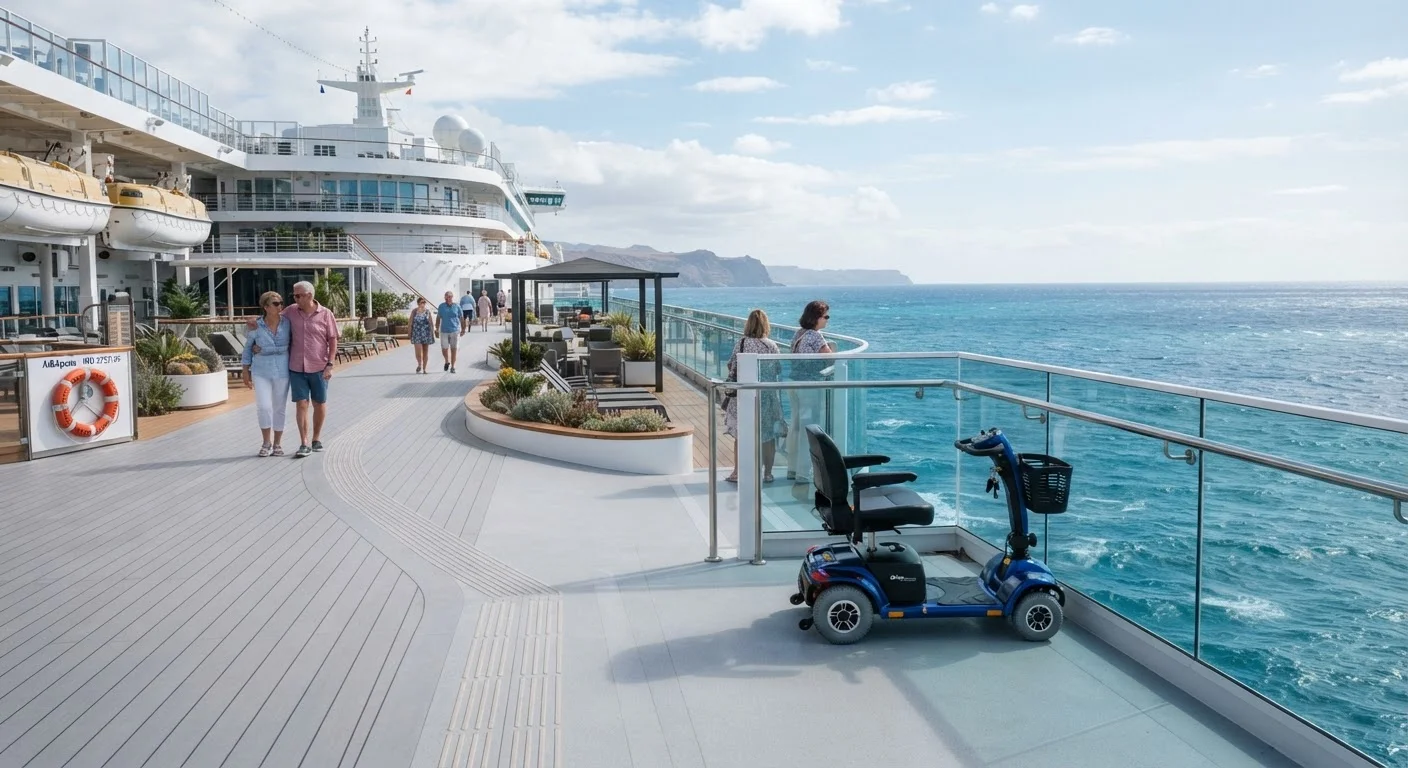
Photo: MyUrbanEscapes.net | Small Escapes. Big Experiences. editorial
—— In This Article
- Why Mobility Aid Users Can Cruise Confidently
- Choosing the Right Ship for Your Mobility Needs
- Accessible Cabin Types: What to Look For
- Gangways, Tenders, and Getting On and Off the Ship
- Shore Excursions and Port Accessibility
- Renting vs. Bringing Your Own Mobility Aid
- Essential Preparation Steps Before You Sail
Key Takeaways
- Book an ADA-accessible or equivalent cabin early — they are limited and fill quickly.
- Tender ports may be inaccessible to power scooters and heavy wheelchairs; check itineraries in advance.
- Notify the cruise line about your mobility aid at booking, not at embarkation.
- Ship-sponsored shore excursions often offer better accessibility guarantees than independent tours.
- Newer, larger ships generally provide wider corridors, more accessible venues, and better elevator ratios.
Why Mobility Aid Users Can Cruise Confidently
Cruising has become one of the most accessible forms of travel for seniors who use wheelchairs, power scooters, or walkers. Unlike land-based trips that require constant transfers between hotels, restaurants, and transport, a cruise keeps your accommodation, dining, and entertainment in one self-contained environment. Once you are aboard, you move on your own terms.
Accessibility standards vary by ship age, size, and cruise line, so informed planning is essential. The good news is that accessibility features have improved substantially across the industry over the past two decades, and dedicated resources exist to help you match your specific needs to the right voyage. For a broader view of health and mobility planning at sea, see our complete overview of cruise health and safety for seniors.
~28 million
North Americans who cruise annually
According to the Cruise Lines International Association (CLIA), cruising continues to grow as a preferred travel format for older adults seeking all-inclusive convenience.
60+ inches
Turning radius in fully accessible cabins
Most major cruise lines specify a minimum 60-inch turning diameter in fully accessible staterooms to accommodate standard power wheelchairs and scooters.
Choosing the Right Ship for Your Mobility Needs
Ship design matters enormously when you use a mobility aid. Newer vessels — especially large and mega-ships built after 2010 — tend to feature wider corridors (often 36 inches or more), automatic doors at venue entrances, roll-in shower cabins, and accessible pools with lifts. Older or smaller ships may have narrower passages, raised thresholds (called sills), and fewer elevators relative to the number of passengers.
When evaluating ships, ask the cruise line directly for the width of cabin doorways in accessible staterooms, the gradient of gangways, and the number of elevators per deck. Our guide to cruise ship accessibility covering cabins, decks, and shore excursions goes deeper on what these design elements mean in practice.
Always ask the cruise line's accessibility desk — not a general reservations agent — to review your cabin's actual floor plan and door measurements before confirming your booking.
General agents may not have technical specifications on hand, while dedicated accessibility teams maintain detailed schematics and can flag potential mismatches between your device dimensions and the cabin layout.
On embarkation day, arrive during the earliest boarding window available. Gangway angles are most manageable at higher tide, and accessible check-in lanes are least congested before peak passenger flow.
Experienced accessibility coordinators at sea note that late-afternoon boarding tends to coincide with steeper gangway gradients and longer waits at accessible facility points.
River cruise ships present a different challenge: they are narrower by design, and gangways can be steep or shared with adjacent vessels at certain docks. If river cruising appeals to you, confirm that your specific ship and itinerary can accommodate your mobility device before booking.
Accessible Cabin Types: What to Look For
Cruise lines designate accessible staterooms using terminology such as fully accessible, ambulatory accessible, or similar labels — meanings differ between lines, so always request written specifications. A fully accessible cabin typically includes:
- A roll-in shower with fold-down bench and hand-held showerhead
- Wider entry door (commonly 32–36 inches clear width)
- Lowered closet rods, light switches, and peepholes
- Turning radius space for power wheelchairs or scooters (often 60 inches)
- Accessible balcony with a flush threshold, where applicable
An ambulatory accessible cabin, by contrast, is designed for guests who walk with difficulty but do not use a wheelchair full-time — it may include grab bars and a shower seat but lack the turning radius needed for a power scooter.
Book Accessible Cabins as Early as Possible
Accessible staterooms are among the first to sell out on most sailings because demand consistently outpaces supply. Some cruise lines limit accessible cabin bookings to guests who have documented needs, but many operate on a first-come basis. Contact the accessibility desk when you first inquire about a voyage rather than waiting until later in the booking process.
Request a cabin location near an elevator bank, as corridor distances on large ships can be significant — sometimes the length of several city blocks from end to end. Our companion article on navigating a ship with a mobility aid explains elevator placement and deck layouts in detail.
Gangways, Tenders, and Getting On and Off the Ship
Embarkation and disembarkation are the two most physically demanding moments of any cruise for mobility aid users. Most modern cruise terminals offer level or gently sloping jet-bridge style gangways, and cruise line staff are trained to assist passengers in wheelchairs. However, gangway angle changes with the tide, so early-morning or late-evening boarding may present steeper slopes.
The more significant challenge arises at tender ports — destinations where the ship anchors offshore and passengers transfer to small motor launches (tenders) to reach the shore. Tenders involve stepping down from a moving ship platform into a bobbing boat, which is unsafe and often impossible for power scooter users and many manual wheelchair users. If an itinerary includes tender ports — common in locations such as Santorini, Halong Bay, and parts of the Caribbean — verify in advance whether mobility aid users will be able to go ashore at those stops.
Tender Ports May Mean You Cannot Go Ashore
At tender ports, cruise lines typically make boarding decisions based on sea conditions and individual passenger circumstances on the day of arrival — there are no guarantees. Power scooter users and passengers in large power wheelchairs are often unable to board tenders safely. If visiting a specific tender port is important to you, speak with the cruise line's accessibility team before booking to understand the realistic likelihood of shore access.
Shore Excursions and Port Accessibility
Port cities vary enormously in their accessibility. Some — such as newer purpose-built terminal areas in Florida or Barcelona — have smooth pavements, ramp access, and accessible transport. Others — including many historic European towns with cobblestone streets and medieval architecture — present substantial barriers for wheeled mobility aids.
Ship-organized shore excursions labeled mobility accessible are generally the most reliable option, as cruise lines vet these for step-free routes, accessible vehicles, and guides experienced with mobility needs. Independent tours can offer more flexibility, but verifying accessibility standards requires direct communication with the tour operator before departure.
If you plan to explore independently, research specific ports by contacting local tourism boards or disability travel organizations. Keep in mind that conditions described online may not reflect current infrastructure, and always have a plan to return to the ship if a port proves unexpectedly inaccessible.
“Accessible travel is not about lowering expectations — it is about matching the right environment to the traveler's needs. Cruising, when planned carefully, can offer seniors with mobility limitations more independence than almost any other form of travel.”
— Cruise Travel Editorial Team, Editors specializing in senior and accessible cruise travel
Renting vs. Bringing Your Own Mobility Aid
Many cruise passengers who use power scooters choose to rent from a mobility equipment company that delivers directly to the ship on embarkation day, rather than transporting their own device through airports and terminals. Rental scooters are typically sized to fit standard accessible cabins and known to fit within ship elevators. This approach removes the complexity of airline handling — a subject covered thoroughly in our guide to traveling with mobility aids by air.
If you bring your own scooter or power wheelchair, confirm the dimensions (width, length, weight) against the ship's accessible cabin specifications. Most cruise lines require that mobility devices be stored inside your stateroom, not in corridors, for safety reasons. Battery type also matters: most cruise lines accept sealed lead-acid and lithium-ion batteries, but requirements vary — request written confirmation from the cruise line before sailing.
Corridor Storage of Mobility Aids Is a Fire Hazard
Cruise line policy — and international maritime safety regulations — generally prohibit leaving scooters, wheelchairs, or any large equipment in cabin corridors overnight. This rule exists because corridors serve as emergency evacuation routes. Verify that your device fits inside your stateroom before sailing; if it does not, contact the accessibility team to explore alternatives.
Essential Preparation Steps Before You Sail
Thorough advance preparation transforms a potentially stressful journey into a manageable one. The following steps are strongly recommended:
- Notify at booking: Inform the cruise line of your mobility aid type, dimensions, and any specific accommodation needs when you first reserve — not at check-in.
- Get written confirmation: Request written confirmation of your accessible cabin's features, not just a category code.
- Review the full itinerary: Identify tender ports and research shore accessibility for each stop.
- Pack a repair kit: For power scooters, carry a basic toolkit, a spare charger, and the manufacturer's contact information.
- Arrange travel insurance: Ensure your policy covers mobility equipment damage or loss and pre-existing conditions. Consult a licensed insurance professional for guidance on coverage options suited to your circumstances.
- Consult your healthcare provider: Discuss the trip with your doctor, particularly if you have cardiovascular, respiratory, or musculoskeletal conditions that may be affected by ship motion, climate changes, or extended excursions.
For a comprehensive checklist covering these steps and more, see our pre-departure accessibility checklist for senior first-time cruisers. The Onboard Experience hub also offers a range of guides on what to expect once aboard.
This article provides general travel information only. Always verify accessibility details directly with your cruise line and port operators before booking. For personal medical advice related to cruising, consult a qualified healthcare professional.

Cruise Travel Editorial Team
Cruise Travel Editorial Team is the collective byline for our editorial team and contributor network. Articles published under this byline or an editorial pen name are researched, written, and reviewed according to our editorial standards for clarity, consistency, and independence before publication.
View author profile