
Managing Medications and Health Supplies During Extended RV Trips
General guidance on organising prescriptions, storing health supplies safely, and planning for medical access while traveling by RV. Always consult your doctor.
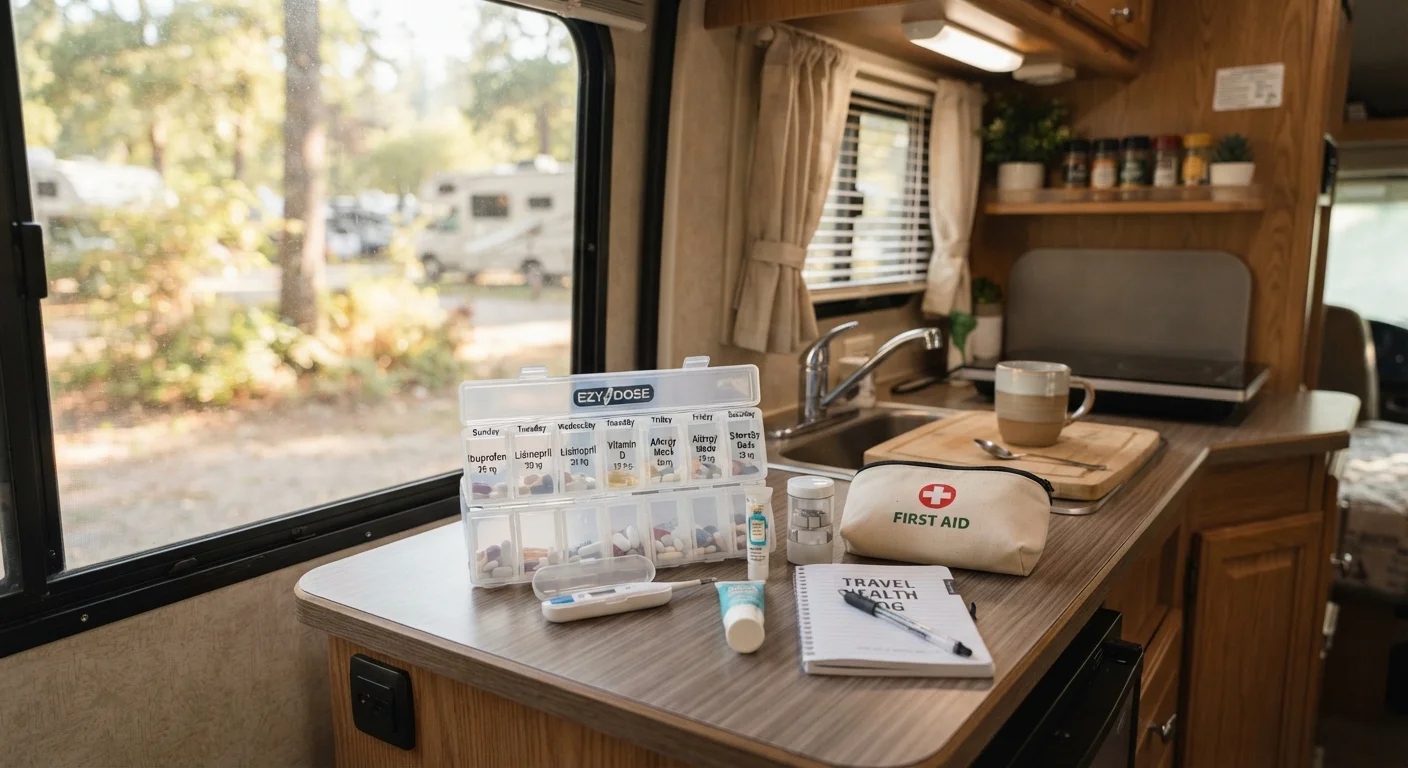
Photo: MyUrbanEscapes.net | Small Escapes. Big Experiences. editorial
—— In This Article
Key Takeaways
- Talk to your doctor before departing to align prescriptions with your full trip duration.
- Store medications according to label requirements — temperature control matters inside an RV.
- Keep a written medication list and emergency contacts in an easily accessible location.
- Research pharmacy availability and urgent care options along your planned route.
- Use a daily pill organizer to reduce missed doses and simplify your routine on the road.
Why Medication Planning Matters More on an Extended RV Trip
A weekend camping trip and a three-month cross-country journey present very different logistical challenges for managing health supplies. On an extended RV trip, you may spend days in areas with limited pharmacy access, experience significant temperature variations that affect medication stability, and encounter situations where seeing your regular doctor quickly is not possible.
Senior RVers managing one or more ongoing health conditions face additional considerations around supply continuity and monitoring. For a broader look at traveling with ongoing health needs, see our guide on RV travel with a chronic condition, which covers general planning strategies alongside the logistics addressed here.
The RV Safety & Comfort hub also contains additional resources relevant to staying healthy and safe on the road. Thoughtful preparation before you leave home is far less stressful than troubleshooting a medication gap from a campsite hundreds of miles from your doctor.
Always Consult Your Healthcare Provider First
This article is general information only and is not a substitute for professional medical advice. Before any extended RV trip, speak with your doctor or pharmacist about your specific medications, storage needs, and health requirements. Never adjust dosages or discontinue medication without medical guidance.
Tools and Preparation You Will Need
Getting organized before departure is the foundation of stress-free medication management. The items below support the steps that follow — some are essential, others are optional but helpful depending on your specific health needs.
7-day pill organizer (with AM/PM slots)
Simplifies daily medication tracking and reduces the risk of missed or doubled doses while traveling.
Insulated medication travel pouch or small cooler
Maintains safe temperatures for medications that require refrigeration or protection from heat.
Waterproof document folder
Protects printed prescription records, insurance cards, and emergency contacts from moisture or damage.
Blood pressure cuff or other personal monitoring device
Allows ongoing monitoring of relevant health metrics between clinic or pharmacy visits.
What you will need
If you are traveling with prescription medications for the first time in an RV context, our related article on traveling with prescription medications covers regulatory considerations in more detail, including rules for controlled substances across state lines.
Step-by-Step: Managing Your Medications on the Road
Follow these steps in order — most of the groundwork happens at home before departure, making the journey itself far smoother. For additional guidance specifically on keeping medications organized during multi-state travel, see our companion article on managing medications on a long RV trip.
Meet with your doctor and pharmacist before departure
Schedule appointments at least three to four weeks before your trip. Ask your doctor to review all current prescriptions with your travel timeline in mind and request early refills where allowed so your supply covers the full duration of your trip. Discuss whether any medications require special documentation — particularly controlled substances — since regulations vary by state. Your pharmacist can flag storage requirements, potential interactions, and advise on travel-safe packaging.
Calculate and pack a sufficient supply with a buffer
Count the days of your trip, then add at least a seven-to-ten-day buffer for each medication in case of delays, changes in route, or difficulty accessing a pharmacy. Divide your supply into a primary container you access daily and a backup quantity kept separately — for example, in a locked storage compartment — in case of loss or spillage. For long trips crossing multiple states, consider whether your mail-order pharmacy can ship refills to a campground address along your route.
Organise medications for daily ease and safety
Use a labeled pill organizer with AM/PM compartments to pre-sort weekly doses before you leave home. Keep this organizer in a consistent, accessible spot inside the RV — not buried in luggage. Store original prescription bottles even if they are not your daily-use containers, as they contain critical label information needed at pharmacies or emergency rooms. Group refrigerated medications together and confirm your RV's refrigerator maintains a stable temperature.
Plan for temperature control inside the RV
Check each medication's storage requirements on the label or package insert. Many common medications should be stored below 77°F (25°C) — a threshold easily exceeded inside a parked RV on a warm day. If your RV is not air-conditioned or you plan extended off-grid stays, use an insulated pouch with a gentle cool pack (not direct ice contact) for heat-sensitive medications. Never store medications in the cab or dashboard area where temperature extremes are greatest.
Create and carry a written health information record
Prepare a single-page document listing all medications with dosages and frequency, known allergies, relevant medical conditions, your doctor's name and phone number, your emergency contact, and your insurance information. Keep one printed copy in the RV's glove compartment or a visible spot near the door, and give a copy to your emergency contact at home. This record is critical if you need emergency care and are unable to communicate clearly.
Map medical resources along your route
Before departure, identify urgent care clinics, hospitals, and pharmacies at intervals along your planned route — particularly in remote stretches. Note which facilities accept your insurance. Many campground hosts and RV communities are knowledgeable about nearby medical resources, but do not rely on this alone. Apps and websites from major pharmacy chains often include store-locator tools that can help, though always verify availability independently before you need it.
Heat Can Degrade Medications Quickly
RV interiors can reach dangerous temperatures when parked in direct sunlight, even on mild days. Many medications lose potency or become unsafe when exposed to excessive heat. Never leave medications in a hot vehicle unattended — always store them in a temperature-stable location or a small cooler with a gentle cool pack if needed.
Keep a Digital Backup of Your Records
Photograph your prescription labels, insurance cards, and your written medication list before departure. Store these images in a secure cloud folder or email them to yourself so you can access them from any device if originals are lost or damaged on the road.
Staying Ahead of Supply and Access Gaps
Even with thorough preparation, unexpected situations arise. A longer-than-planned stay, a detour through a remote area, or a lost bag can disrupt even the best systems. The key habit to build is checking your medication supply at each new destination — not waiting until you are nearly out. Many mail-order pharmacy services allow shipments to alternative addresses, including campground offices, which can be arranged in advance for known stops.
For a concise pre-departure checklist approach, our article on medication management on the road walks through the critical steps seniors should complete before leaving home. Staying connected with your health team via telehealth appointments is also increasingly practical for RVers — ask your provider whether this is an option for check-ins during your trip.
The Health & Safety hub provides further guidance on staying comfortable and prepared throughout your journey as a senior traveler.
This article is for general informational and educational purposes only. It is not medical advice. Always consult your doctor, pharmacist, or a qualified healthcare professional regarding your specific medications, health conditions, and travel needs before departing on any trip.

Rv Travel Editorial Team
RV Travel Editorial Team is the collective byline for our editorial team and contributor network. Articles published under this byline or an editorial pen name are researched, written, and reviewed according to our editorial standards for clarity, consistency, and independence before publication.
View author profile