
Full-Hookup vs. Primitive Camping: What Senior RVers Need to Weigh Before Booking
Comparing full-hookup RV sites and primitive campsites to help senior travelers choose the setup that best fits their comfort and health needs.
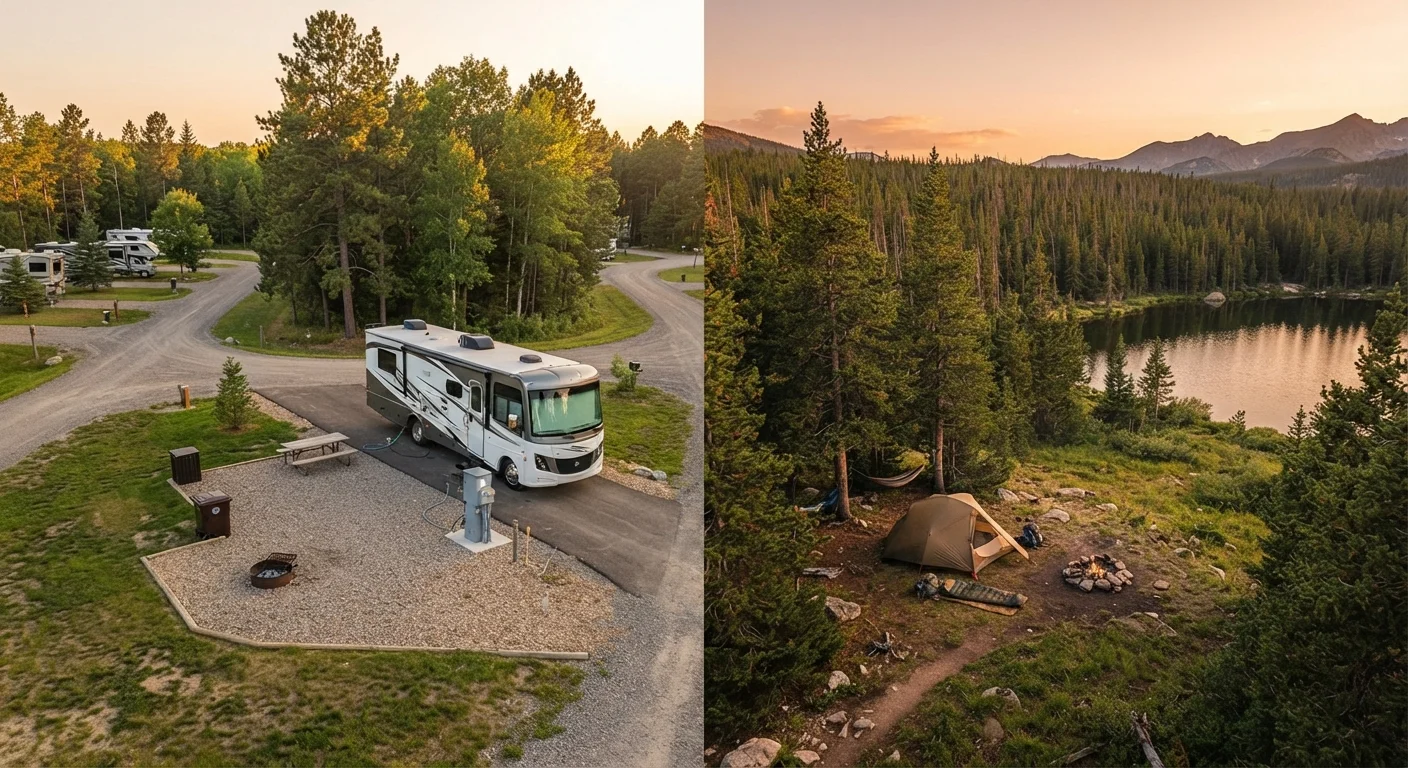
Photo: MyUrbanEscapes.net | Small Escapes. Big Experiences. editorial
—— In This Article
Key Takeaways
- Full-hookup sites provide electricity, water, and sewer connections — eliminating the need to manage onboard tank levels daily.
- Primitive campsites typically lack utility connections, requiring careful water, power, and waste management from your RV's onboard systems.
- Medical equipment like CPAP machines and refrigerated medications makes reliable electrical access a safety priority, not just a comfort one.
- Primitive sites often offer more natural scenery and solitude but may involve rougher terrain, limited cell service, and no nearby emergency support.
- Many senior RVers use a hybrid approach — booking full-hookup sites as a home base while taking day trips into more remote areas.
What Each Setup Actually Means on the Ground
Before weighing the trade-offs, it helps to understand exactly what each option involves. Full-hookup camping means your RV site includes a direct electrical connection (typically 30 or 50 amp), a fresh-water supply line, and a sewer hookup for wastewater. You run your appliances continuously, top off water without thinking, and never worry about dumping tanks mid-trip. For a deeper look at what these connections entail day-to-day, see what full-hookup camping means in practice.
Primitive camping — sometimes called dry camping or boondocking — means arriving at a site with no utility connections whatsoever. You rely entirely on your RV's onboard fresh-water tank, battery bank, and holding tanks for gray and black water. You generate power through solar panels, a generator, or a combination of both. When tanks fill or batteries run low, you move on or seek a dump station.
The physical demands of each setup differ considerably. Full-hookup sites typically sit within organized campgrounds where you connect a few hoses and cables after parking. Primitive sites may require navigating unpaved access roads, leveling on uneven ground, and managing systems more actively throughout your stay.
Health and Safety Factors Senior RVers Should Weigh Carefully
For many senior travelers, campsite choice isn't purely about preference — it directly affects health management and personal safety. This is worth thinking through honestly before booking.
1 in 3
Senior adults live with at least one chronic condition
According to the U.S. Centers for Disease Control and Prevention, chronic conditions are common among adults 65 and older, making reliable utility access an important campsite consideration.
30+ min
Typical emergency response delay in remote areas
Rural and wilderness areas frequently have significantly longer emergency response times compared to urban and suburban campgrounds, a factor worth weighing when choosing remote sites.
Power-dependent medical devices are one of the most concrete deciding factors. CPAP and BiPAP machines, powered mobility aids, electric blankets for circulation issues, and refrigerated insulin or other medications all require stable electricity. While a lithium battery bank can support some devices for a night or two, primitive camping over multiple nights introduces real risk if power management isn't precise. When in doubt, shore power removes that variable entirely.
Proximity to emergency services is another consideration that primitive camping complicates. Remote sites may be 30 or more minutes from the nearest town, and cell coverage is often unreliable. Full-hookup campgrounds, by contrast, typically have staff on site or nearby, often have neighbors close enough to summon help, and are located in areas with better emergency response times.
Terrain matters, too. Primitive sites may involve soft soil, uneven surfaces, or rocky approaches that increase fall risk when walking around the rig at night. Always consult your own healthcare provider about how your specific health needs should inform your travel planning — this article provides general educational context, not personal medical guidance. For broader safety and comfort strategies, the RV Safety & Comfort hub offers a range of useful resources.
Side-by-Side: How Full-Hookup and Primitive Sites Compare
The table below distills the key practical differences across the criteria that matter most to senior RVers.
| Criterion | Full-Hookup | Primitive Camping |
|---|---|---|
| Electrical access | Shore power (30 or 50 amp) | Solar, generator, or battery only |
| Water supply | Continuous city water connection | Onboard fresh-water tank only |
| Waste management | Direct sewer hookup | Holding tanks; requires dump station |
| Typical nightly cost | Higher (organized campground rates) | Low to free (public lands) |
| Site terrain | Usually level, often paved or graveled | Variable; may be uneven or unpaved |
| Proximity to emergency services | Generally close to towns | Often remote; limited cell coverage |
| Privacy and solitude | Moderate; neighbors close by | High; isolated settings common |
| Accessibility features | More likely (restrooms, paved pads) | Rarely available |
It's worth noting that not all full-hookup campgrounds offer the same quality of amenities, and not all primitive sites are equally remote or inaccessible. State parks and private RV resorts that both offer full hookups can differ significantly in accessibility features, site spacing, road conditions, and available support — factors that matter just as much as the hookup itself.
The Hybrid Strategy Many Experienced Senior RVers Use
A growing number of senior RVers don't frame this as an either/or decision. Instead, they use full-hookup sites as a stabilizing home base — somewhere to rest, recharge batteries (literal and personal), do laundry, and top off water — while taking day trips into more remote or scenic areas that primitive camping would typically occupy.
This approach captures the best of both setups without committing to the demands of extended off-grid stays. You wake up in a comfortable, connected site, drive out to a national forest or open public land for the day, and return to reliable utilities in the evening. It's particularly well-suited to seniors traveling alone or with a partner who wants nature immersion without logistical pressure.
Trying a Test Run First
If you're curious about primitive camping but unsure whether it suits your needs, consider a one-night stay at a semi-remote site close to a town before committing to multi-day off-grid travel. This lets you stress-test your RV's water capacity, battery performance, and your own comfort level without being far from support. Many experienced senior RVers recommend this approach before any extended backcountry stay.
If you're still working out your overall planning approach, practical insights from experienced senior RVers covers lessons many travelers wish they'd had before their first trip. And for those thinking about extended stays rather than trip-by-trip booking, long-stay RV site decisions addresses common oversights worth knowing in advance.

Rv Travel Editorial Team
RV Travel Editorial Team is the collective byline for our editorial team and contributor network. Articles published under this byline or an editorial pen name are researched, written, and reviewed according to our editorial standards for clarity, consistency, and independence before publication.
View author profile