
Carrying Your Medical History Abroad: Formats, Documents, and What's Actually Useful
A summary of your health history can be critical in an emergency overseas. Learn what to include, how to format it, and how to keep it accessible.
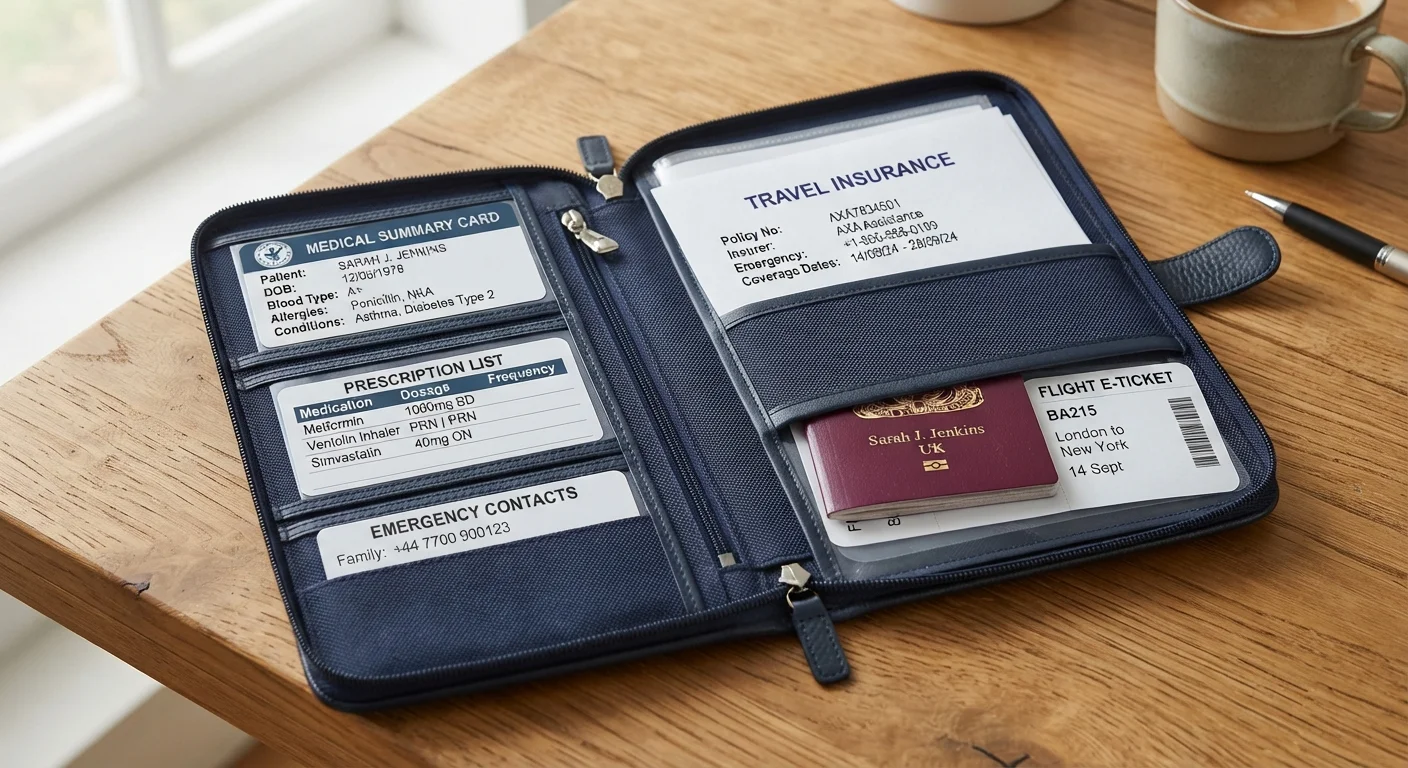
Photo: MyUrbanEscapes.net | Small Escapes. Big Experiences. editorial
—— In This Article
Why a Medical Summary Matters Overseas
When you seek care far from home — whether at a clinic in rural Portugal or an emergency room in Tokyo — local providers have no access to your medical records. A concise, well-organized medical summary closes that gap. It gives clinicians the context they need to treat you safely, reduce harmful drug interactions, and avoid procedures that conflict with your existing conditions.
For senior travelers managing chronic conditions, multiple prescriptions, or implanted devices, this document isn't optional — it's a fundamental safety tool. Think of it as a portable snapshot of your health that any trained clinician, anywhere in the world, can read and act on quickly.
This is general health information intended to support your pre-travel planning. Always consult your own physician before traveling, particularly if you manage complex or serious health conditions.
| Recommended document length | 1–2 pages maximum (General clinical guidance for emergency medical summaries) |
| Key medication detail to include | Generic drug name, dose, and frequency (WHO and international pharmacy practice standards) |
| Copies recommended | At least 3: carry-on, separate bag, and home contact (General travel health best practice) |
| Update frequency | Before each trip, or after any medication or diagnosis change (Recommended by travel medicine practitioners) |
| Languages to consider | English plus destination country language for non-English-speaking regions (Travel health advisory guidance) |
What to Include in Your Medical Summary
Keep the document focused. Emergency providers need key facts fast — not your full decade of visit notes. A practical medical summary for international travel should cover:
- Diagnoses: List active and significant past conditions using both common names and, if known, clinical terms (e.g., "Type 2 diabetes / diabetes mellitus").
- Current medications: Include generic drug name, brand name, dose, and frequency. Avoid relying on brand names alone, as they vary by country. See our guide to traveling with prescription medications for documentation tips that complement this list.
- Allergies and adverse reactions: Specify the substance and the reaction type (e.g., "penicillin — anaphylaxis"). Vague "allergies" entries are less useful than precise descriptions.
- Implanted devices: Pacemakers, stents, joint replacements, and cochlear implants are critical for imaging and procedural decisions. Note the device type, model if known, and implant date.
- Recent procedures or surgeries: Include dates and brief descriptions for anything within the past two to three years.
- Blood type: Optional but can be helpful in emergencies.
- Emergency contacts: At least one person with their relationship to you, phone number (with country code), and whether they have medical power of attorney.
Your primary care physician can help you draft this summary accurately. Many practices will generate one on request as part of pre-travel preparation. For longer trips, also review our article on planning around health appointments to keep chronic condition management on track while away.
Medical summary
A concise, portable document summarizing a patient's active diagnoses, medications, allergies, and key health history. It is designed to be quickly understood by clinicians who have no prior knowledge of the patient.
Generic drug name
The standardized, non-proprietary name of a medication active ingredient (e.g., metformin), as distinct from its brand name (e.g., Glucophage). Generic names are consistent across countries, making them more reliable for international use.
Medical power of attorney
A legal document authorizing a designated person to make healthcare decisions on your behalf if you are unable to do so. Requirements and recognition vary by country.
Implanted device
Any medically placed device inside the body, such as a pacemaker, cardiac stent, artificial joint, or insulin pump. These must be disclosed to providers before imaging or certain procedures.
Formats, Copies, and Accessibility
The format of your medical summary affects how useful it actually is in a crisis. Consider maintaining it in multiple forms:
- One-page printed card: A single laminated or card-stock sheet in your wallet is the most immediately accessible format for first responders. Keep it concise — ideally fitting within two sides of one page.
- Digital file: A PDF stored in a password-protected cloud service (accessible via browser on any device) ensures you have a backup if physical documents are lost. Share access instructions with your emergency contact at home.
- USB drive: Useful, though not universally readable in all clinical settings. Treat it as a supplement, not a primary format.
Language is a practical consideration. If you're traveling to a country where English is not widely spoken in medical settings, consider having a translated version prepared. Your travel insurer, the destination country's consulate, or a professional medical translation service can assist. Avoid relying solely on machine-translated versions for clinical content.
Keep physical copies in at least two locations — your carry-on and a separate bag — to guard against loss. A copy left with a trusted contact at home adds another layer of security. This fits naturally into a broader emergency plan; our article on building a senior travel emergency plan covers the full document and contact checklist.
For cruise travelers, your ship's medical center staff will also benefit from having this summary on file at embarkation. See the Cruise Health & Safety hub for guidance specific to that environment.
Digital Access Requires Planning Ahead
Storing your medical summary digitally is only useful if you can actually access it abroad. Before departure, confirm your cloud service is available in your destination country and that you know your login credentials without relying on autofill. Consider emailing a copy to yourself as a reliable backup that requires only a browser and internet access.

Travel Health & Safety Editorial Team
Travel Health & Safety Editorial Team is the collective byline for our editorial team and contributor network. Articles published under this byline or an editorial pen name are researched, written, and reviewed according to our editorial standards for clarity, consistency, and independence before publication.
View author profile